In modern corporate communications and regulatory affairs, organizations face a common bottleneck: data is fragmented across external social channels, local municipal announcements, industry newsletters, and regulatory filings. Traditional social listening tools come with steep enterprise price tags, ranging from $20,000 to over $100,000 annually per platform, while forcing teams to repeatedly scrape and analyze overlapping datasets across multiple isolated departments.
Solving the Fragmented Agent Problem: The "Single Source of Truth" Foundation
The critical challenge encountered when developing departmental AI agents is that independent agents querying the internet for the same information return divergent answers. Because unconstrained web search models allow agents free rein to pull live results on demand, timing discrepancies, shifting search algorithms, and disparate source selection create operational friction and conflicting business intelligence.
To solve this, the NJR Agentic Intelligence Platform shifts from an on-demand search model to a governed data foundation. Data collection is centralized so that all specialized advisory agents evaluate the exact same verified baseline of organizational knowledge.
Explicit Data Source Definition: Inputs are clearly defined, spanning social media platforms (Facebook, Instagram, LinkedIn, YouTube), municipal websites, monthly newsletters, stock market data, and Bloomberg dashboards.
Strict Refresh & Retention Cadences: Automated schedules dictate how often data is refreshed and how long it is retained from each specific source.
Taxonomy & Relational Structuring: Keywords, grouping terms, and explicit relationships are established to provide cross-departmental context.
Security-Driven Access Control: SharePoint folder structures mapped directly to Active Directory security roles govern information access.
Architecture Overview: The Two-Layer Paradigm
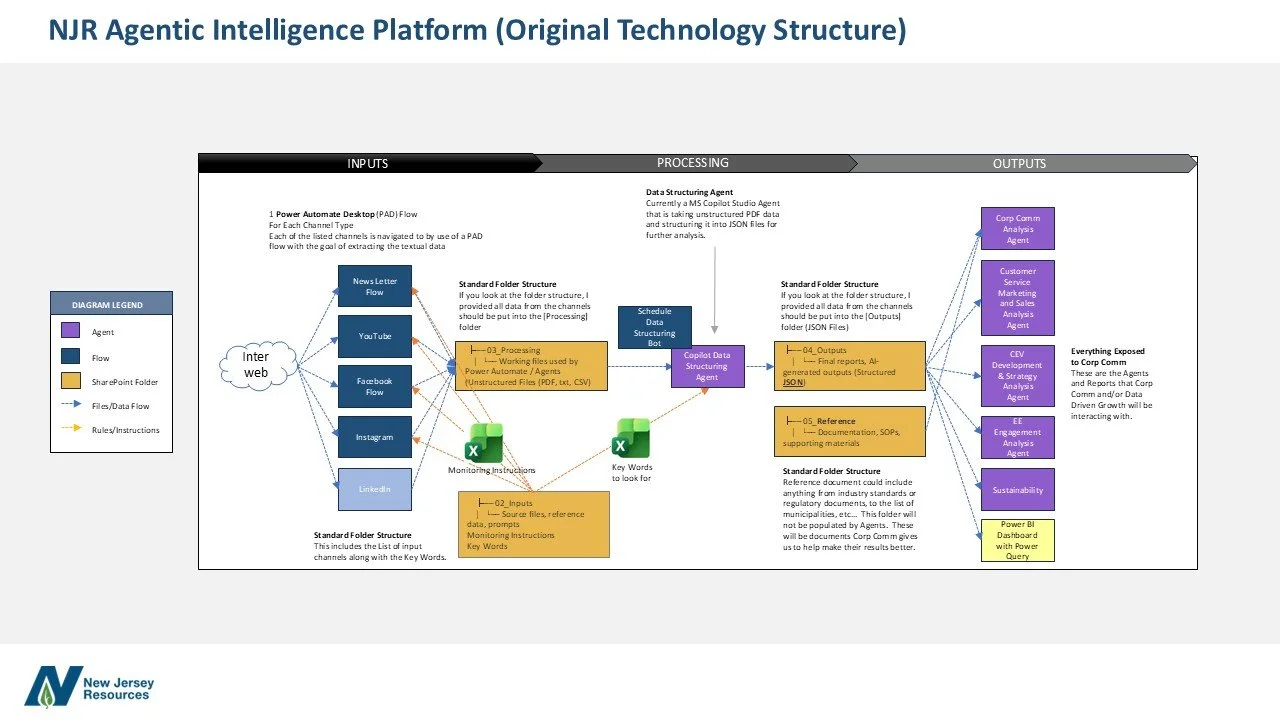
The platform separates data ingestion from end-user advisory consumption into two distinct, governed tiers:
Layer 1: The Intelligent Data Foundation
Responsible for automated data harvesting across channels using Power Automate Desktop (PAD) flows and structured folder hierarchies. Unstructured artifacts are normalized into clean, relational JSON formats, eliminating duplicate collection cycles.
Layer 2: The Intelligent Advisory Network
A suite of specialized AI advisors powered by a single source of truth. Rather than each department independently querying the web, specialized agents leverage the pre-structured data foundation to deliver proactive recommendations, sentiment tracking, and risk alerts.
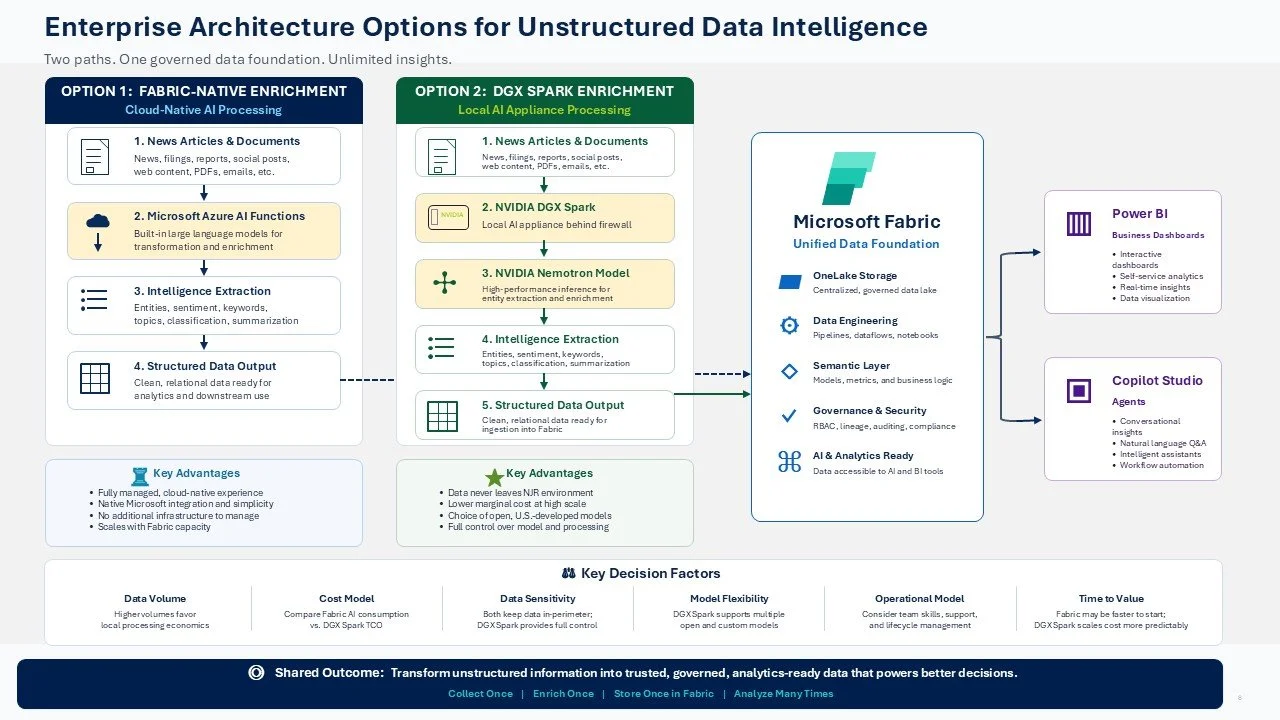
Departmental Use Cases & Stakeholders
The platform supports a diverse ecosystem of internal business units and specialized analytical agents designed for specific functional leaders:
Corp Comm Analysis Agent: Monitors the 9 closest regional competitors and tracks public sentiment, media coverage, and emerging narrative friction vectors.
Customer Service Marketing and Sales Analysis Agent: Focuses on monitoring regional construction companies, developer activity, and municipal updates.
CEV Development & Strategy Analysis Agent: Tracks PJM market intelligence, transmission issues, capacity auctions, and clean energy adoption trends.
EE Engagement Analysis Agent: Analyzes communications from local municipalities, retirement communities, and schools to measure community engagement.
Sustainability: Tracks environmental initiatives, solar incentive adoption, and ESG-related market discussions.
Investor Relations: Monitors financial sentiment, market positioning, and peer corporate disclosures.
Executive & Strategic Leadership: Utilizes enterprise-wide aggregations for high-level decision support.
Advanced Analytical Dashboards & Intelligence Widgets
The platform feeds data directly into executive-facing Power BI dashboards equipped with advanced decision-support mechanisms:
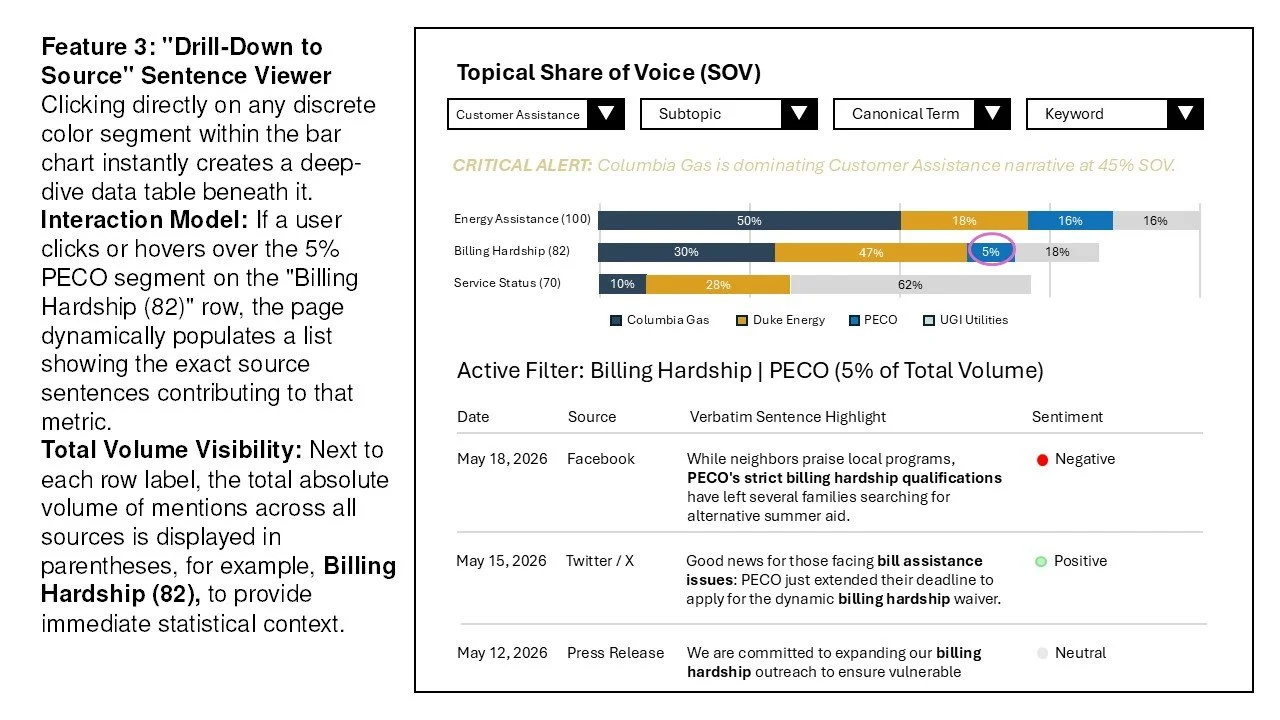
Topical Share of Voice (SOV) & Drill-Down Matrix: Instantly highlights competitive narrative dominance (e.g., tracking when a peer utility commands 45% SOV on customer assistance) and allows users to click directly into underlying verbatim sentences categorized by sentiment.
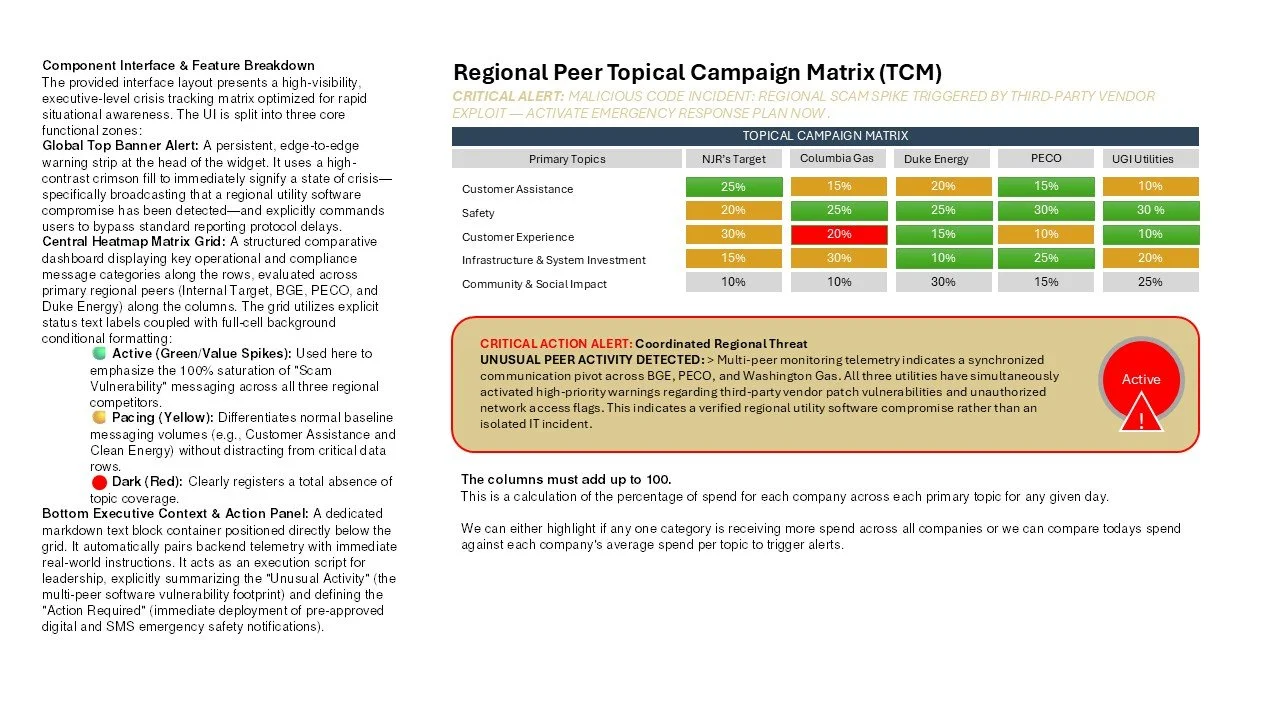
Regional Peer Topical Campaign Matrix (TCM): A high-visibility crisis-tracking grid that normalizes spending/messaging percentages across primary topics (Customer Assistance, Safety, Customer Experience, Infrastructure) while providing real-time anomaly alerts for regional IT or security incidents.
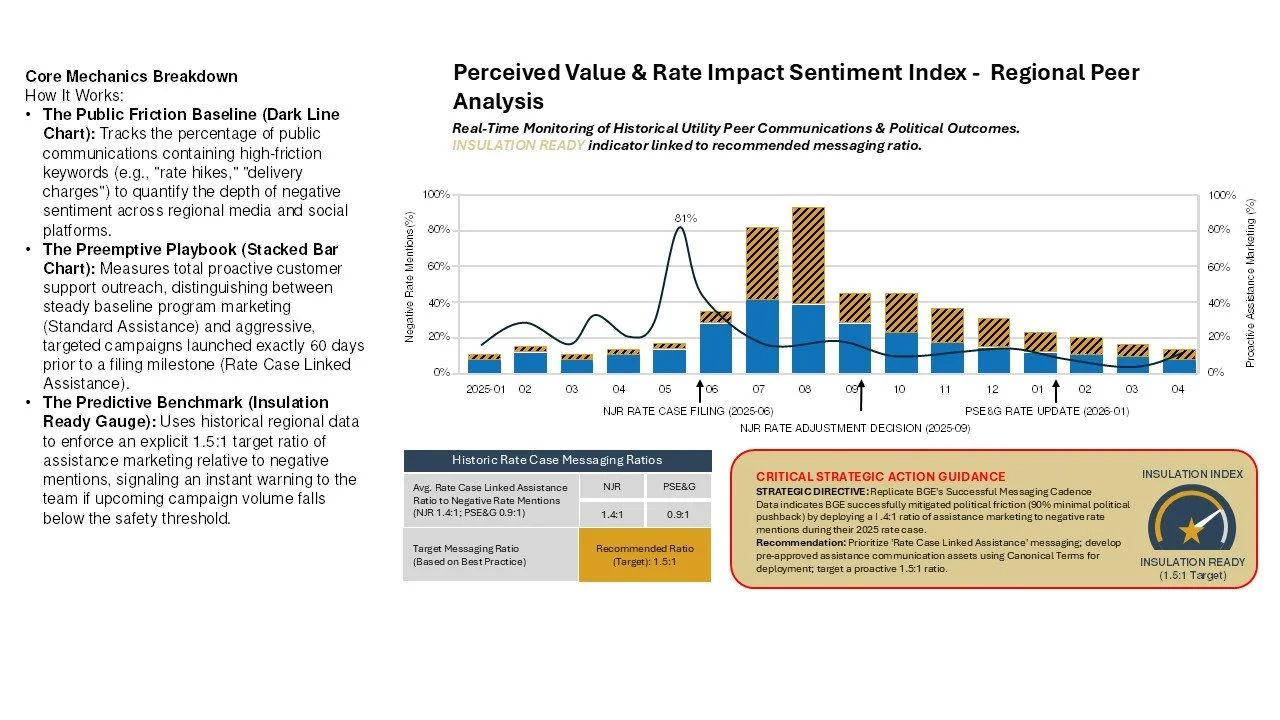
Perceived Value & Rate Impact Sentiment Index: Combines historical rate case timelines with proactive campaign ratios to enforce an optimal 1.5:1 target assistance marketing ratio relative to negative rate mentions.
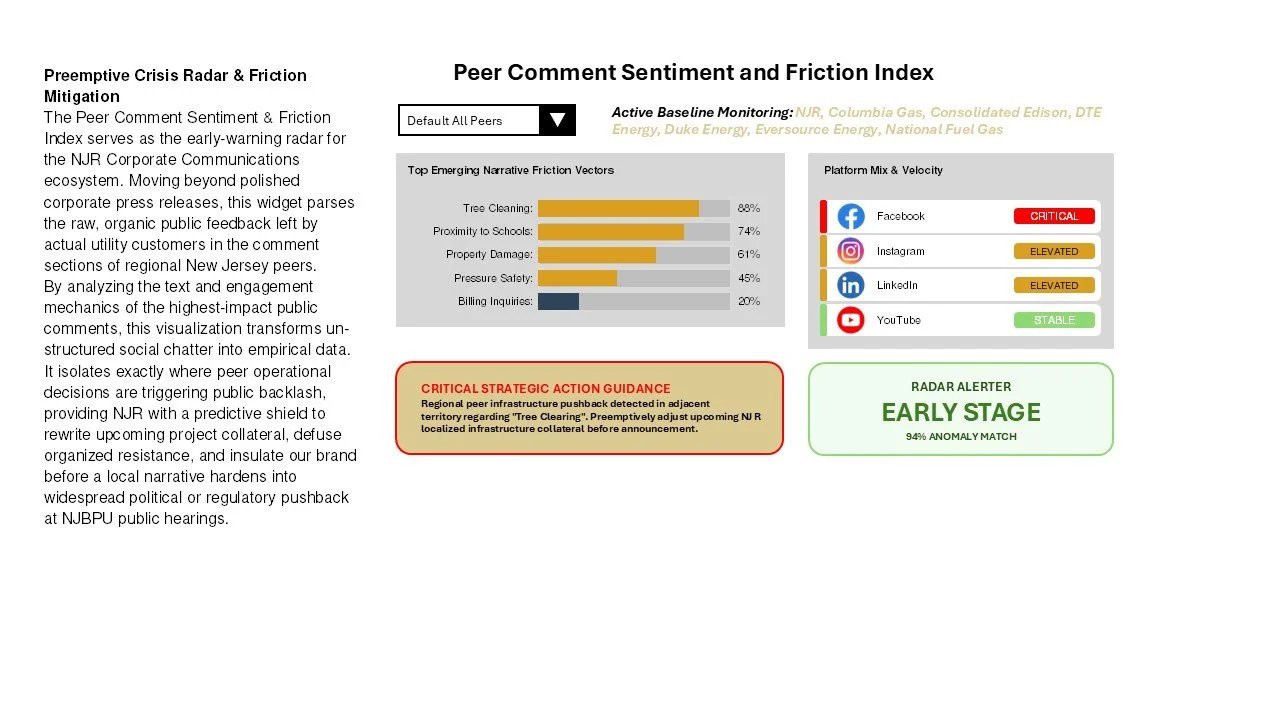
Peer Comment Sentiment and Friction Index: Evaluates organic public feedback in comment sections to detect early-stage friction (such as tree clearing or proximity to schools) before issues escalate to formal public hearings.
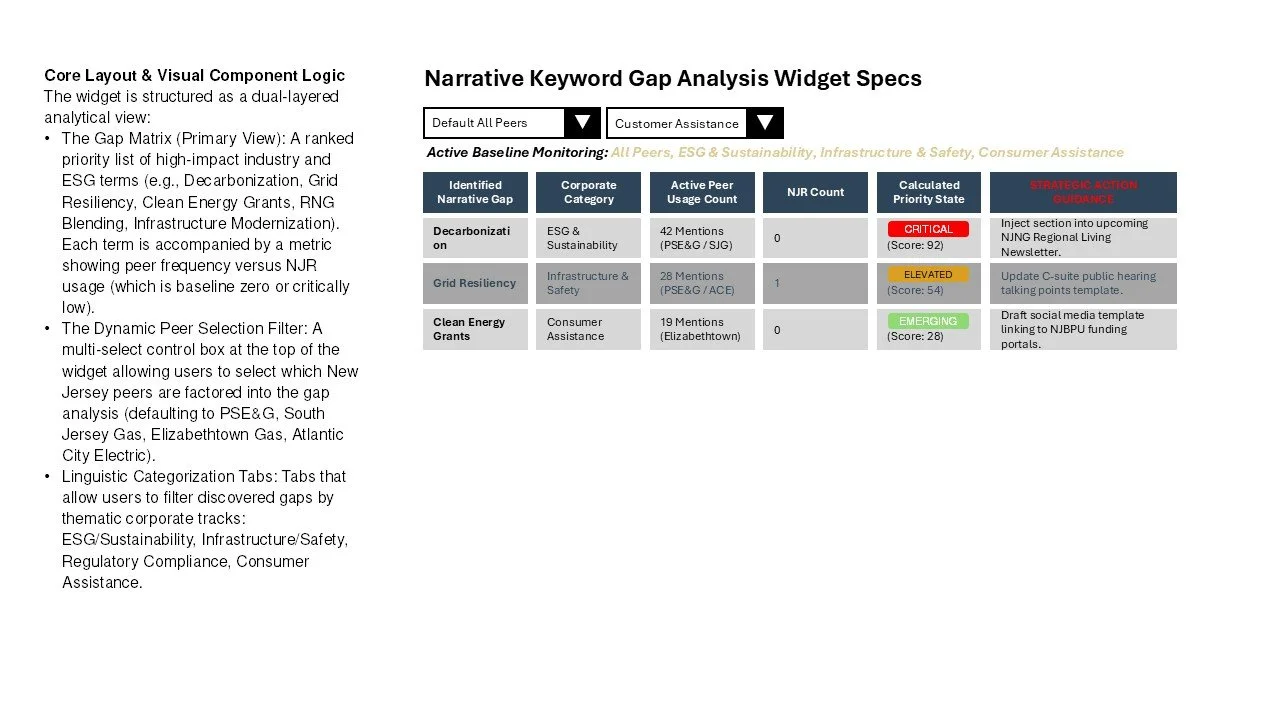
Narrative Keyword Gap Analysis: Ranks high-impact ESG and industry terms (e.g., Decarbonization, Grid Resiliency) against peer usage to automatically trigger content adjustments in upcoming corporate newsletters.
Enterprise Strategic Value & Business Outcomes
By consolidating commercial software requirements—which would otherwise demand individual enterprise subscriptions for social listening ($50k), website monitoring ($15k), newsletter ingestion ($10k), and AI analysis layers ($20k)—the platform prevents massive software bloat.
Ultimately, replacing fragmented manual research with a governed data foundation delivers tangible enterprise outcomes:
Elimination of Redundant Costs: Slashes expensive third-party licensing bloat across multiple business units.
Guaranteed Consistency: Eliminates contradictory agent responses by ensuring every specialized advisor evaluates the exact same verified baseline of organizational knowledge.
New Operational Synergies: Blends real-time public sentiment data with internal operational metrics to actively address rate case concerns, predict future infrastructure demand, and accelerate customer issue resolution.